Showing posts with label Research. Show all posts

Visual Typology of Twisted or Plaited Viking Age -Rings. Part 2.

Legend:  Visual Typology of Viking Age
Finger-, Arm-, and Neck-Rings, Figure 1.
This is Part 2 of my blog post series on the visual Typology I've worked on for twisted and/or plaited Viking Age (VA) Finger-Rings, Arm-Rings, and Neck-Rings (-Rings). In this post I will be covering the Legend of my visual typology so that the examples I post in my third blog post will make more sense.

Part 1 covered the most important elements, the metal rods and/or wire they forged and then twisted and/or plaited to form their -Rings.


[IMAGE]
Legend:  Visual Typology of Viking Age Finger-, Arm-, and Neck-Rings, Figure 1

The examples are shown as Cross-Sections to better illustrate the various parts.


SETS: Are usually 2 or 3 Strands, but can be more, of Wire or Rod; most often Twisted together Clockwise. Rods can be tapered at the ends so that the middle is the thickest/widest point.

Example shown. SET  1 x 2, Twisted Clockwise 


BUNDLES: Are usually 2 or 3 Sets, but can be more; most often Plaited together Counter Clockwise.

Example shown. BUNDLE  1 x 2, Plaited Counter Clockwise


Embellishments: Are optional decorative elements for Sets or Bundles, and they are made using Wires of a much smaller diameter than the primary ones used to make the Sets. They are usually either 1 Beaded Wire or made up of 1 or 2 Round Wires. When there are 2 or more Wires they are most often Twisted together Clockwise. 

Embellishments are seated in the 'valleys' created when the Sets are Twisted or the Bundles are Plaited. This means that the same number of Embellishment Wires are used as there are Strands in the Set, or the number of Sets in the Bundle.


Please Note:
Currently, there is no formal descriptive nomenclature to define this based on Ted Bouck's research and networking across the globe, as well as in my own research. My definitions are based on the ones developed by Ted Bouck, which I agree with, he will more fully define them in the future. Please refer to his document, "The processes used to make a twisted or plaited Viking Age "style" armring." Definitions used with permission from Ted Bouck who retails full Copyrights.


All graphics of my Visual Typology of twisted and/or plaited Viking Age Finger-Rings, Arm-Rings, and Neck-Rings are Copyrighted by me.

Visual Typology of Twisted or Plaited Viking Age -Rings. Part 1.

Various Shapes of Forged Wire or Rod
for Viking Age -Rings, Figure 1.
This is Part 1 of my blog post series on the visual Typology I've worked on for twisted and/or plaited Viking Age (VA) Finger-Rings, Arm-Rings, and Neck-Rings (-Rings). 

In this post I will be covering the most important elements, the metal rods and/or wire they forged and then twisted and/or plaited to form their -Rings.


[IMAGE]
Various Shapes of Forged Wire or Rod for Viking Age -Rings, Figure 1.

The extant finds are predominately made of Gold or Silver (sometimes referred to as Fine Silver) as well Gold Alloys (23 Karats and below) or Silver Alloys.  There are also some -Rings identified as 'Copper Alloy' or Bronze

Unfortunately, the majority have NOT been tested to determine their exact metallic compositions. Somewhat vague terms tend to be used, which can cause confusion, usually based on how they look.

Example, 'Copper Alloys' could mean any of the various Brass(es) or Bronze(s) we use today, but they are referring to Brass. 


Non-Modern Labels for 'Copper Alloys'

The blanket term 'Copper Alloy' is used within Archaeology to label and encompass a variety of Brass items. The main component of Brass is Copper (Cu) and its secondary one is Zinc (Zn). Even if this alloy is referred to as 'Bronze' it is still 'Brass' because it contains Zinc (Zn) and not Tin (Sn). 

Bronze is an alloy of Copper (Cu) and Tin (Sn). This blanket term does not specify the percentages of either element in the alloy, this can also be seen with the above term used for a Brass, 'Copper Alloy'.


Copper Alloy =  Brass = Copper (Cu) and Zinc (Zn)

                          Bronze = Copper (Cu) and Tin (Sn)


The Copper Development Association (CDA)

The Copper Development Association (CDA) is an international association that sets the standards for Copper and Copper alloys. They do this by creating internationally recognised ID code numbers that should be strictly followed when using their ID Codes to avoid confusion. 

For example Nickel Silver's CDA code number can be written in any of the following formats: 
CDA#752, CDA #752, CDA 752 or Alloy 752, etc. This specifically identified Copper alloy contain 65% Copper (Cu), 17% Zinc (Zn), and 18% Nickel (Ni), and it goes by various names depending on the sellers preferences: Nickel Silver, German Silver, Nickel Alloy, etc..


The CDA code number can be written in many different ways, as seen above, and yet mean the same thing. Using the CDA approved code for a specified Alloy ensures that the mix of metallic elements, that we are referring to, is the exact Alloy we mean so that there is no doubt. 


I have been unable to find a complete list of the CDA's standards and Alloy code numbers, on any of their websites. Most vendors use different terms for the same Alloy which quickly gets confusing so I compiled information from various websites, PDFs and tables into a table on my personal website entitled, 'Metal Alloy Table'.

For additional information and links please see the section entitled, 'Copper Development Association (CDA)' on my 'Metal Suppliers' resource page. 


Modern ID Codes for Copper Alloys

CDA#230: The modern alloy containing 85% Copper (Cu) and 15% Zinc (Zn), is referred to as Red Brass, Jeweler's Brass, NuGold, Jeweler's Bronze, etc..

CDA#260: The modern alloy containing 70% Copper (Cu) and 30% Zinc (Zn), is referred to as Yellow Brass or Cartridge Brass, etc..


Modern ID Codes for Copper Alloys: Bronze

CDA#521: The modern alloy containing 92% Copper (Cu) and 8% Tin (Sn) is Bronze and it is also referred to as Phosphor Bronze or Grade "C" Phosphor Bronze. 

CDA#521 is also significantly close to the proportions of tested extant Bronze items.


Forging an Ingot into Various
Shapes of Wire or Rod, Figure 2.
[IMAGE]
Forging an Ingot into Various Shapes of Wire or Rod, Figure 2.

On a flat anvil, place your wire or rod while holding it with a pair of pliers, hammer from one end to the other along each corner's length and use consistent force. Rotate the wire or rod a quarter turn and repeat these steps until it has parallel sides and a polygon cross-section.


Stages:
Ingot > Square [4] > Octagon [8] > Hexadecagonal [16] > Triacontadigonal [32] > Circle


Anneal when the metal's length is doubled or the thickness is halved. Use the appropriate heat for the metal being used, immediately quench it in clean water. Use non-Ferris tweezers to place it in a warm pickle solution to remove any oxidation. Thoroughly wash the metal and dry the surface before continuing.  

Annealing returns work hardened metal to dead soft by returning its Ductility.

Remove the ragged ends with a saw or use a sharp cutting chisel. Rotate a 1/4 turn after each chisel strike and repeat until you cut through. Leaving the ragged ends could leave cracks or flaking that could get bigger as you work the metal causing a great deal of damage.

Late Anglo-Saxon Disk-Brooches. Part 6. (Enamelling Tools)

Goldsmithing and Enameling Tools: Iron Hoods / Muffles and Trays.

This is Part 6 of my series of blog posts related to my Late Anglo-Saxon Enamel Disk-Brooch project on the historical tools used in Goldsmithing and Enamelling from approximately the 2nd-century BCE until the middle of the 2nd-millennium CE.
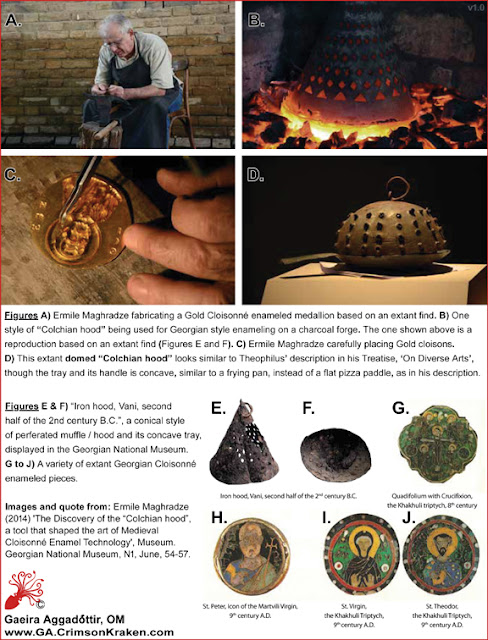

Figures A to J.

I was inspired by the hood/muffle sets that two fellow Enamelers each fabricated and
based on Theophilus' description from, 'On Diverse Arts'. A couple of years ago I saw the set made by THL Alys Treeby, my Apprentice Belt-Sister, she's had multiple successful enamel firings on a Blacksmith's charcoal heated forge. Recently Sir Ælfwyn Langanwuda sent me photographs of the set she fabricated. This past weekend she was able to use it with great success on her period bead kiln that she's repurposed, previously she used a blacksmith's forge as a heat source. Both of their hoods are appropriately 3-inches in diameter.


In May of this year, Doug Colin Guyton fabricated for me a perforated, domed hood/muffle and tray (see Figure M.) based on my research of Theophilus' Treatise, ‘On Diverse Arts’. Both the domed extant and reproduction pieces have handles though shaped differently. Theophilus' description is of a flat tray similar to a pizza paddle, and the domed Georgian extant tray is concave, similar to a frying pan.
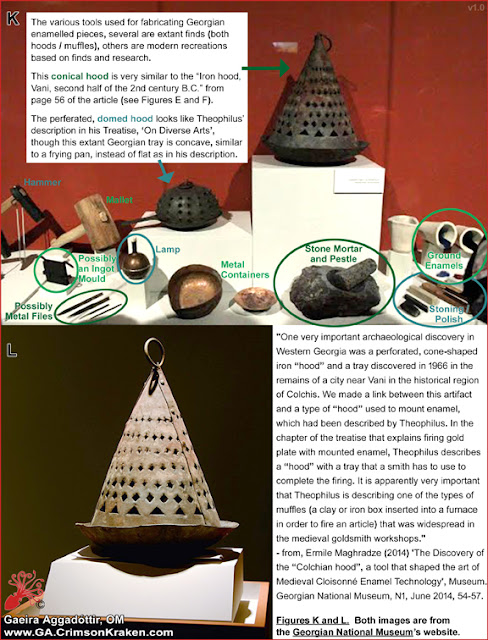
Figures K and L.


Over the next year I plan to experiment with my muffle set using a charcoal forge to solder, enamel and fuse. I hope to fabricate another domed muffle/hood as well as conical shaped ones, based on the extant finds of the “Iron hood, Vani, second half of the 2nd century B.C.”.


The hood/muffle and its tray are used on a charcoal forge (see Figures B and O) or with a furnace, both are smaller than what Blacksmiths use(d). They are placed on top of heated charcoal and other heated pieces of charcoal are piled a couple of inches high around the hood. Since the holes in the hood/muffle were punched from the interior outwards, the sharp edges of the cut and stretched metal point outwards, much like a cheese grater, and help reduce how much ash and particles can enter. The charcoal quickly heats the metal and interior space. Once the needed temperature range and time have been reached then the charcoal can be carefully brushed away from the sides and the entire hood/muffle and tray can be removed from the forge or furnace. 


"A copy of the Colchian cloisonné hood was made and tested, which showed that the Colchian “hood" is a goldsmith's tool – an iron muffle. If placed underneath a pile of burning coals as described by Theophilus, high temperatures are achieved inside the muffle and a highly skilled jeweler can perform work on glass, gold or silver." (Ermile Maghradze, Nature, June 2014)


I am researching the writings of three other historical figures in hopes of finding more information on the tools and techniques of pre-Renaissance soldering, fusing, and enameling techniques. I will continue to write blog posts of my experiments and findings over the coming year.
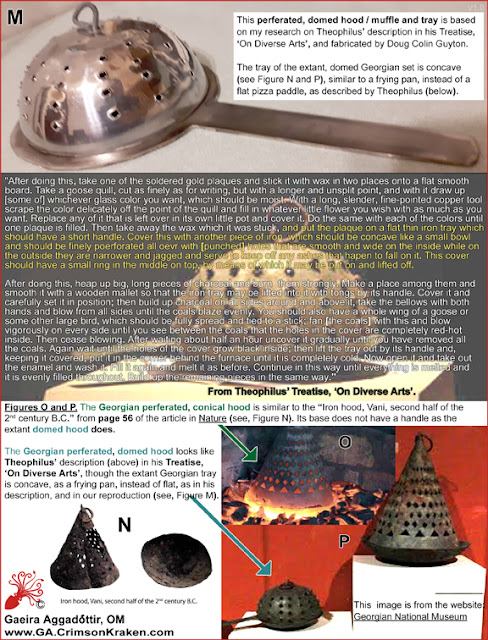


Figures M to P.

Figure A. 
Ermile Maghradze fabricating a Gold Cloisonné enameled medallion based on an extant find. 


Figure B. 
One style of “Colchian hood” being used for Georgian style enameling on a charcoal forge. The one shown above is a reproduction based on an extant find (see Figure K and L). 


Figure C. 
Ermile Maghradze placing Gold cloisons on the back plate. 


Figure D. 
The perforated, domed hood looks like Theophilus’ description in his Treatise, ‘On Diverse Arts’, though this extant Georgian base is concave, similar to a frying pan, instead of flat like a pizza paddle, as in his description. 


Figures E & F. 
“Iron hood, Vani, second half of the 2nd century B.C.”, a conical style of perforated muffle / hood and its base, displayed in the Georgian National Museum. 


Figures G to J. 
A variety of Georgian Cloisonné enameled pieces.


Figure K.
The various tools used for fabricating Georgian enameled pieces, several are extant finds (both hoods), others are modern recreations based on finds and research. 


This conical hood is very similar to the “Iron hood, Vani, second half of the 2nd century B.C.” from page 57 of the article. 


The perforated, domed hood looks like Theophilus’ description in his Treatise, ‘On Diverse Arts’, though this Georgian base is concave, similar to a frying pan, instead of flat as in his description.


Figure L.
"One very important archaeological discovery in Western Georgia was a perforated, cone-shaped iron “hood” and a tray discovered in 1966 in the remains of a city near Vani in the historical region of Colchis. We made a link between this artifact and a type of “hood” used to mount enamel, which had been described by Theophilus. In the chapter of the treatise that explains firing gold plate with mounted enamel, Theophilus describes a “hood” with a tray that a smith has to use to complete the firing. It is apparently very important that Theophilus is describing one of the types of muffles (a clay or iron box inserted into a furnace in order to fire an article) that was widespread in the medieval goldsmith workshops."
- from, Ermile Maghradze (2014) 'The Discovery of the “Colchian hood”, a tool that shaped the art of Medieval Cloisonné Enamel Technology', Museum. Georgian National Museum, N1, June 2014, 54-57.


Figure M.
This perforated, domed hood was fabricated by Doug Colin Guyton based on my research of Theophilus’ description from his Treatise, ‘On Diverse Arts’. 


The base of the domed Georgian extant set is concave, similar to a frying pan, instead of flat like a pizza paddle, as the version that Theophilus was familiar with.


Figures O and P. 
The conical hood is similar to the “Iron hood, Vani, second half of the 2nd century B.C.” from page 57 of the article in Nature. Its base does not have a handle like the domed hood.


Figure P.
The perforated, domed hood looks like Theophilus’ description in his Treatise, ‘On Diverse Arts’, though this Georgian base is concave, similar to a frying pan, instead of flat as above in our Theophilus reproduction.


Figures A thru J, N, O, and several quotes are from: 
Ermile Maghradze (2014) 'The Discovery of the “Colchian hood”, a tool that shaped the art of Medieval Cloisonné Enamel Technology', Museum. Georgian National Museum, N1, June, 54-57.


Figure M.
Photograph by Gaeira Aggadottir.


Figures K, L, and P.  
These images are from the Georgian National Museum’s website.

Resource: My Video Tutorials and Demos on Vimeo

Gaeira's Anvil...Videos
You can now find my Video Tutorials and Demos on my Vimeo page, Gaeira's Anvil...Videos

I will be uploading my videos on my Vimeo page instead of on fb and posting information and a link as I make and upload new ones.

Please leave constructive criticism so I can improve my future video sessions. The 4 current ones, which were previously posted on FB, will most likely be replaced at some point with updated versions as I improve my video making skills.

https://vimeo.com/gaeirasanvil

Research Progress (a.k.a. ‘Rabbit Holes’)

I started researching Byzantine and Georgian Enameling for a project, got briefly side tracked by the Limoges pieces at the MET, which I was fortunate enough to see in person, then I came across Late Anglo-Saxon enabled brooches and fell hard for them. This opened a new rabbit hole.

I wanted to know how they made their enamels and if they used the same glass as they used in their glass beads, which there a lot more extant examples of than their enameled items. I started researching glass and found that there wasn't much at all mentioned in Late period publications about it, I would later figure out that there is only a fraction written about Late Anglo-Saxon compared to Early or even Middle period.

I noticed it mentioned in several publications that Byzantine enamels, and those made in Britain after the fall of Rome, were made from scavenged Tesserae, glass tiles used in mosaics, found in many Roman buildings. So they weren't making their own glass or enamels from scratch, but scavenging used pieces to either remelt to make beads or crushed them to make their enamels. 

This led to researching Roman glass production, shipping, as well as glass made at the time outside of the Roman Empire and earlier, to glass chemistry and sources for the components. Also to the practice of recycling Roman glass after the fall of Rome.

I looked for modern makers of Roman glass that I could purchase to experiment with my making glass beads and my own enamels. I found a small handful that say it's Roman glass, but my concern is the source of the main component, the sand source. Every beach or area that sand is found is made from a different rock or combination or rocks. The type of rock makes a great difference in the characteristics and properties of the glass made. So I wanted to try and make my own especially if I couldn't purchase their Roman glass or if I found it wasn't chemically the same. So I looked into period methods of glass production and current Experimental Archaeology being done.

I asked my friends on Facebook if they lived near a beach or source of sand and where they were. It turns out a great number of them are near a source and it covers the continental US, minus Alaska. I even have a couple of friends in different parts of Canada then where live that could send/bring me sand. I researched current shipping laws about importing sand into Canada and fortunately I can bring in anything from the continental USA. Sadly not from my European friends which are in great locations. I need to look into anywhere here in Canada or the US that imports sand from Europe and if I can get sand from the same sources used by Rome.

If I can put together a kiln that could melt the ingredients to make my own glass then I can make a variety from all the sand my friends will give me and any I can purchase. 

I wanted to find out why there weren't any grave finds of these Late Anglo- Saxon enameled brooches and why they were all found with metal detectors. I found out that grave and burial practices changed (Christianity) about this time or earlier leading to not burying their prized possessions with them as they did for centuries before.

I'm still trying to find Late Anglo-Saxon research on their glass and enamel, but there's very little and it's not exactly what I need.

After I find enough about glass and enamel I will start in deeper on Anglo-Saxon metalwork, sources for their metals, and their production methods. I've found a bit so far, but not as much as I'd prefer.

I'm a Goldsmith and plan to make my own sheet metal from melting the metal (Red Brass CDA#230), pouring an ingot, and rolling it into sheet using my rolling mill. The joint issues that I have, especially those with my hands and arms, don't allow me to hammer the Copper Alloy out into sheets since it would be too harsh on them, so I will use a modern rolling mill which has replaced hammering out sheet. If I was using a high Karat Gold or even Fine Silver, both of which are far more malleable than Brasses, I might be able to hammer them into sheet without injuring or causing inflammation to my hand and arm joints. I would like to try to make my own Gold and Silver Leaf at some point.

I'm going to experiment with modern glass bead rods, which are uses in modern bead making, Flameworking, to make my own enamels from them to get the feel of making them myself from pieces of glass even though it's not Roman glass. If I manage to find Roman glass I'll experiment with it as well.

With the help of my Laurel I'll be making an amalgam of Mercury and Gold to try a period Gilding method used by the Anglo-Saxons and several other cultures. I won't be Gilding an entire brooch due to the costs and health concerns, I just want to try making and using a small quantity for the experience.

After this research and project is complete I plan to research and make cast Roman enameled brooches.

Vikings! Exhibit Photographs on Flickr

Vikings! Exhibit on Flickr Web Page
I was fortunate enough to be able to travel twice to Gatineau, Quebec to see the traveling exhibition, Vikings! which took place at the Canadian Museum of History.

These pictures were taken at the  'Vikings' exhibit held at the museum from 3Dec2015 to 17Apr2016.

This was the largest exhibition of Viking Age items to travel to Canada, and probably worldwide, that I have heard of.


Link: https://www.flickr.com/photos/gaeira/albums

My Academia.edu Page

https://independent.academia.edu/GaeiraAggadottir
For several years now I have been on Academia.edu researching a wide selection of topics and enjoying my discoveries. This week I added links to several of my Blog posts and will continue to do so as I post about my various research and fabrication projects.

If you haven't already discovered this wonderful community of researchers please take the time to go over and see how it is set up. The basic membership is free and that gives you a profile page and the ability to upload files as well as download files.

Since I am not affiliated with a college or university I am considered an independent researcher.


Link: 
https://independent.academia.edu/GaeiraAggadottir

Viking Age: Jewelry

Viking Age: Jewelry Web Page
There are several dozen metalsmithing related links in my "Viking Age: Jewelry" section located at the top of the left-hand menu on my A&S website, Gaeira's Anvil.

Links to Viking Age related published papers, thesis, articles, tutorials, museums, databases, etc.


Viking Age: Jewelry Links

Metallic
Construction

Brooches

Non-Metallic

Lampwork, Glass Beads 

Icelandic Vikings

Icelandic Viking Web Page
After years of online research and a great deal of frustration, I have gathered resources scattered around the web and created a section about Icelandic Vikings. It is the largest resource I have seen about them to date.

There are also several dozen Viking Age related links in my "Viking Age: Jewelry" and "Viking Age: Textile" sections, located at the top of the left-hand menu on my A&S website, Gaeira's Anvil


Research: Articles, publications, theses, dissertations, and other sources.

Textiles: Nålebinding, Warp-Weighted Loom, Tablet Weaving, etc.

Icelandic Wool: Wool from Icelandic Sheep. 

Buriel: Buriel practices and research.

Animals: Icelandic animals.

Icelandic Wool: From Icelandic Sheep

Miscellany: A mix of topics: music, etc.

Viking Age: Vikings, the Norse

Viking Age: Vikings, the Norse Web Page

There are several dozen Viking Age related links in my "Viking Age: Jewelry" and "Viking Age: Textile" sections, located at the top of the left-hand menu on my A&S website, Gaeira's Anvil.

Anything that doesn't fall between either category can be found in my section, Viking Age: Vikings, the Norse

VIKINGs/Norse Links

They highlight a wide range of topics, with a bit more attention to metalsmithing and textile arts related to Vikings and Medieval Europe:

Arts: Viking Age Arts and Crafts.

Buriel: Buriel practices and research

Clothing: Resources and links related to Viking Age clothing except for "Female Viking 'Apron' Dress (VAD*)"

'Heraldic' Display: Boat 'weather vanes', other displays and sailing.

Viking/ON Names: Links to resources to help find period Old Norse / Viking Age names.

Runes: Resources and links related to Viking Age Runestones and Picturestones

Conferences and Organizations

Voyages: The expansion and travel by the Vikings/Norse

Miscellany: A mix of topics: the Sagas, Scandinavia(ns), Rus Vikings, etc. 

Crimson Kraken on Pinterest

Pinterest is a beautiful rabbit hole and one of my homes...with well over 10,000 pins on my board, CKraken, covering jewelry and textiles the Viking Age and beyond. I've posted inspiring images, links to tutorials, research finds, and a variety of resources. Jump in!


Link: CKraken
CKraken on Pinterest

Pinned Post

Welcome to my new blog site.

I look forward to posting about my on going projects and research here. I would like to share with you links to my various online researc...